
Guide
AI can read my site, so why is my score only 57?
A site can be fully readable by AI and still score 57 on Blanc. The score doesn't measure whether AI can see your page. It measures how easy you make it for AI to understand your page, choose it as an answer and quote it correctly. This guide explains what the score means, what a truly unreadable site looks like, and how to check every finding yourself.
If AI can answer questions about my site, why did I score 57?
Because being readable and being easy to quote are different things, and the score counts both.
Here's a real result from a Blanc audit:
| Section | Score | What it means |
|---|---|---|
| AI crawler access | 23/25 | AI crawlers are allowed in |
| Technical readability | 15/15 | The content is in the page, not hidden behind JavaScript |
| Answer-ready content | 18/30 | Facts are there, but thin or not stated up front |
| Schema and entities | 0/30 | No structured data telling machines who you are and what you offer |
| Total | 57/100 |
The owner of this site was right: AI can read it. The first two rows say exactly that. Almost all of the missing 43 points come from the last two: the page has no structured data, and its key facts aren't always where an AI looks for them, such as a direct answer right under a question heading.
So the score isn't asking "can AI see you?" It's asking how easy you make it for AI to pick your page as the answer and quote it correctly.
Why doesn't asking ChatGPT about my own site prove anything?
Because naming your site or pasting its link tells the AI exactly which page to open. That's the easy case.
The questions that bring customers are different: "best physiotherapist in Makati", "kid-friendly cafes near BGC", "booking software for small clinics under $50". There, the AI chooses between many sites, and nobody points it at yours. It tends to favour pages whose facts are clear, specific and easy to quote.
A better test takes two minutes:
- Write down 3 to 5 questions a real customer would ask, without your business name in them.
- Ask them in ChatGPT, Perplexity and Copilot, with web search on.
- Use a private or signed-out window, so your own history doesn't tilt the answers toward you.
- Note whether your site gets cited, which sites do, and how those pages state their facts.
That tells you far more than asking about yourself.
What does a score look like when AI really can't read a site?
The headline tells you, not the total. When Blanc finds a critical problem, the result says "AI engines can't read this page yet", whatever the number.
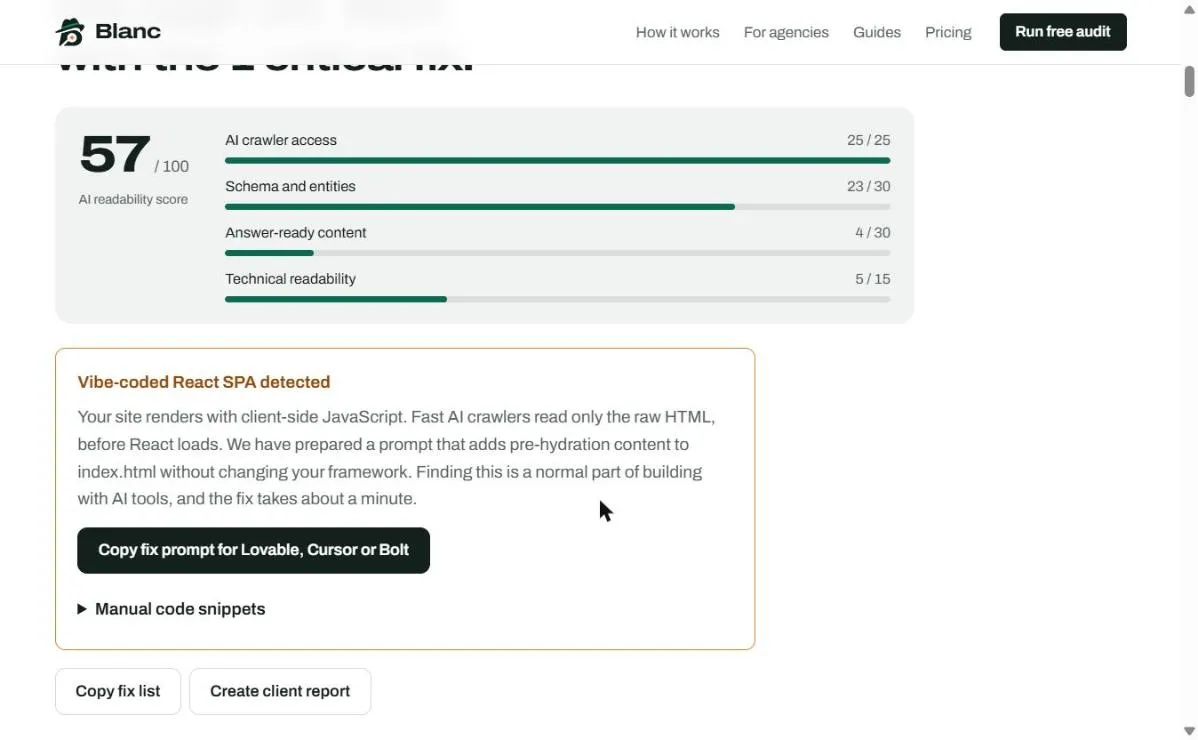
Two sites can both score 57 for opposite reasons. Here's the site above next to NearMe Kids PH before its fix:
| NearMe Kids PH, before | The site above | |
|---|---|---|
| Total | 57 | 57 |
| AI crawler access | 25/25 | 23/25 |
| Technical readability | 5/15 | 15/15 |
| Answer-ready content | 4/30 | 18/30 |
| Schema and entities | 23/30 | 0/30 |
| Headline | AI engines can't read this page yet | AI engines can read this page, with gaps |
| What it means | Not readable: crawlers received 9 words | Readable, but hard to understand and quote |
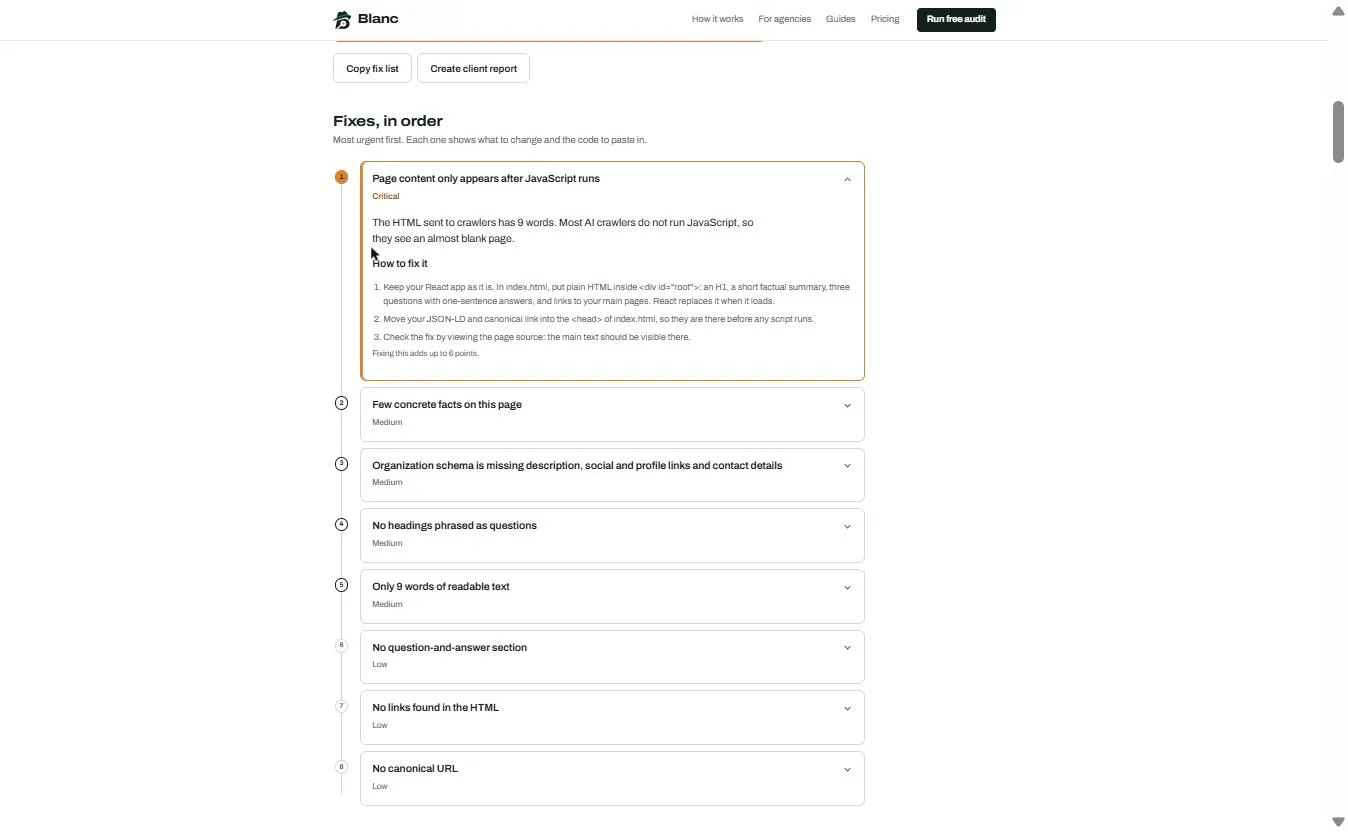
These findings mean AI really can't read a page:
- robots.txt blocks AI crawlers. Search engines like ChatGPT's and Perplexity's are told not to visit.
- A noindex tag. The page asks engines not to list it.
- Content only appears after JavaScript runs. Most AI crawlers don't run JavaScript, so they receive an almost empty page. NearMe Kids PH sent crawlers 9 words.
- A firewall or bot challenge turns crawlers away before they reach the page.
If you see none of these and your access and technical scores are high, AI can read your page. The rest of the score is about how well it can use what it reads.
How can I check my score without trusting Blanc?
Every finding comes with its evidence, and you can confirm each one yourself with free tools.
| What to check | How | Confirms |
|---|---|---|
| Are AI crawlers blocked? | Open yoursite.com/robots.txt and look for Disallow lines under GPTBot, OAI-SearchBot, ClaudeBot, PerplexityBot or User-agent: *. |
Crawler access |
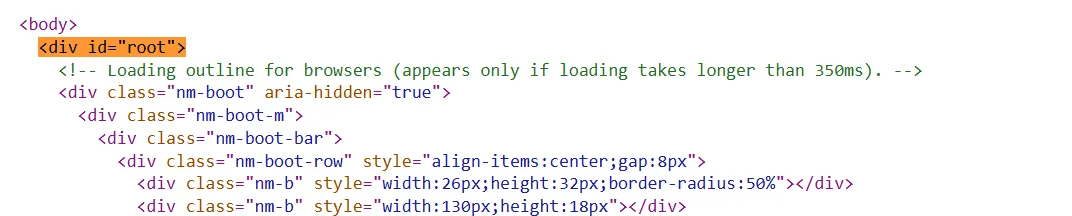
| Can crawlers read your content? | Right-click the page and choose View page source (or press Ctrl+U). Search for your main headline. Don't use Inspect: it shows the page after JavaScript has run. | Technical readability |
| Does a firewall block bots? | Run curl -A "OAI-SearchBot" https://yoursite.com/. A 403 error or a challenge page means crawlers are being turned away. |
Crawler access |
| Is there structured data? | Paste your page into validator.schema.org or Google's Rich Results Test. | Schema and entities |
| Do AI crawlers actually visit? | Check your server or Cloudflare logs for visits from OAI-SearchBot, PerplexityBot or Claude-SearchBot, and the status codes they got. |
Crawler access |
| Does Microsoft's AI cite you? | Bing Webmaster Tools has an AI Performance report with real Copilot citation counts. | The outcome |
| Do AI answers mention you? | The customer-question test above, in a signed-out window. | The outcome |
The last two measure results, not readability. They depend on more than your own site, so treat them as a direction, not a verdict.
How is the score calculated?
The score is Blanc's own way of ranking what to fix first. It isn't an industry standard, and no AI company publishes a score like it.
| Section | Points | What it checks |
|---|---|---|
| AI crawler access | 25 | robots.txt, noindex, firewalls, whether the page loads for crawlers |
| Schema and entities | 30 | Structured data that states who you are and what you offer |
| Answer-ready content | 30 | Concrete facts, question headings with direct answers, enough text to quote |
| Technical readability | 15 | Content in the HTML the server sends, links, title, description |
The bands are a rough guide: 85 and above is ready, 60 to 84 needs work, and below 60 is weak.
What you can rely on are the findings: the exact robots.txt line, the word count in your HTML, the missing schema. Those are facts you can check with the tools above. The weighting decides which fix appears first.
Do I need schema to appear in Google's AI answers?
No. Google says its AI features don't need special optimization or special structured data.
Google's guide to AI features and your website says normal SEO fundamentals still apply to AI Overviews and AI Mode, such as allowing crawling, keeping important content in text and making sure structured data matches the visible page. There's no special schema to add for them.
So why does Blanc give schema 30 points? Because Google isn't the only engine reading your site. Structured data states your business type, location, prices and services in a form any machine can read without guessing, which helps every engine and every tool that summarises your page. Treat it as making your facts clear, not as a switch for Google's AI answers. And only add schema that matches what's visible on the page.
Will a higher score get me cited by AI?
Not on its own. A higher score removes the reasons an engine might skip or misread your page. Whether it cites you also depends on what other sites, reviews, roundups and press say about you.
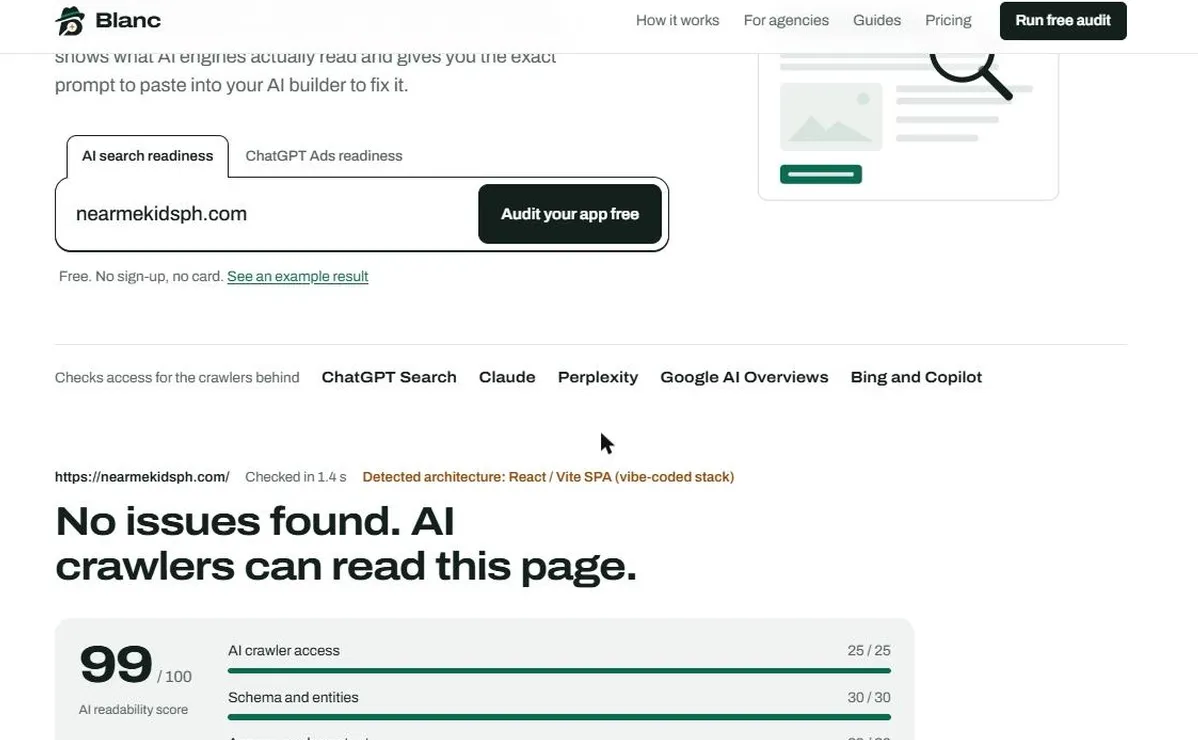
The proof that fixes matter comes from before-and-after results on real sites. In the NearMe Kids PH case study, the homepage went from 57 to 99, and the article tracks real AI traffic and Copilot citations from Bing Webmaster Tools alongside the score.
When is a low score worth fixing?
It depends on why it's low:
- The headline says AI can't read your page: fix it first. Until crawlers can read the page, nothing else on it can help you.
- Your page is readable, but schema or answer-ready content is low: the fixes are usually small, like adding structured data or stating prices, locations and hours plainly. They make your facts easier to use, without promising citations.
- You manage sites for clients: a readable before-and-after shows clients exactly what changed and why.
Sources
- AI features and your website, Google Search Central
- The rise of the AI crawler, Vercel and MERJ, December 2024